December 2, 2017
Teaching Social, Emotional, and Behavioral Self-Management Skills to All Students: The Cognitive-Behavioral Science Underlying the Success of The Stop & Think Social Skills Program

Don’t We Really Just Want Students to “Stop & Think”? [Part III of III]
Dear Colleagues,
Introduction
We have known for decades that students’ social, emotional, and behavioral competency and self-management in school is essential to their academic and interpersonal success.
We have similarly known that a cognitive-behavioral approach that uses instruction grounded in social learning theory (Teach, Model, Role-play, Provide Feedback, and Apply the Training to Real-life) is the best social, emotional, and behavioral approach when (a) teaching students interpersonal and interactional skills, and (b) addressing the serious, extreme, and complex needs of emotionally disturbed and behaviorally disruptive students.
And yet, despite this longstanding research and well-established and effective cognitive-behavioral approaches, districts and schools across the country continue to jump on the Mindfulness bandwagon—in their (unsuccessful) search to attain these “21st Century” interpersonal and interactional outcomes.
The primary goal of this three-part Series is to discuss these points in detail—identifying the flaws and weaknesses in mindfulness strategies and programs, while then discussing the science-to-practice cognitive-behavioral principles that make social, emotional, and behavioral skill instruction successful.
And throughout this Series, the primary theme is:
If the primary goal (for educators) in using a Mindfulness program is to help students to be more aware and in control of their emotions, thoughts, and behavior, why would they use unproven approaches . . . when research-based cognitive-behavioral approaches—with over 30 years of research documentation—are available instead?
Summarizing Parts I and II of this Series: Mindfulness vs. Self-Management
To “set the stage” for Part III of this Series (still below), let’s briefly recap Parts I and II:
In Part I of this Series, we discussed the past and current research, efficacy, and realities of Mindfulness programs in schools across the country, and the $1.1 billion industry-fed “bandwagon” that many districts have “jumped on” over the past few years.
Overall, the research cited in Part I made the following points:
- Most of the Mindfulness program research has either not been methodologically sound, or it has not produced objective and demonstrable success.
- The few studies that have shown “good evidence” have focused on adults with clinically-significant mental health issues (anxiety, depression, and pain), not on school-aged students.
- Rather than use the few studies that have shown “good evidence” to rationalize the use of Mindfulness in schools (or worse, someone’s subjective, personal pronouncements), educators need to read the substantial body of research that should eliminate the use of Mindfulness programs in schools.
- Sound research has not definitively demonstrated that Mindfulness programs are successful at the preventative (e.g., Tier 1) level in schools. In fact, the Behavior Research and Therapy study cited in Part I indicates the opposite.
- There are a significant number of large school districts and other schools (covered by the popular press) that are wasting precious professional development and classroom time and money on this fad.
- Students who need evidence-based approaches to address their social, emotional, and behavioral needs—but are receiving Mindfulness training instead—are potentially being harmed because more effective services are being delayed.
- Students would be far better served if their districts and schools were providing multi-tiered social skills training and cognitive-behavioral therapy approaches—given their long histories of demonstrated efficacy in hundreds of studies with school-aged students.
_ _ _ _ _ _
In Part II of this Series, we used the evidence-based Stop & Think Social Skills Program as an exemplar of how to teach students social, emotional, and behavioral self-management through a social skills instructional curriculum.
Initially, we defined Self-Management as a child or adolescent’s ability:
- To be socially, emotionally, and behaviorally aware of themselves and others;
- To effectively control their emotions, as well as their thoughts, beliefs, expectations, and attributions; and
- To behaviorally demonstrate successful interpersonal, social problem-solving, conflict prevention and resolution, and emotional coping skills.
We then noted that:
On a social level, children and adolescents need to progressively learn the self-management skills that contribute to effective: (a) listening, engagement, and responding; (b) communication and collaboration; (c) social problem-solving and group interactions; and (d) (once again) conflict prevention and resolution.
On an emotional level, they need to learn the self-management skills that result in: (a) the awareness of their own and others’ feelings; (b) the ability to manage or control their feelings and emotions; (c) the ability to cope with the emotional effects of current situations; and (d) the ability to demonstrate appropriate behavior even under conditions of emotionality.
Finally, on a behavioral level, children and adolescents need to learn the self-management skills that help them to be actively engaged in and responsible for their own learning (individually, and in small and large groups), and to demonstrate appropriate behavior in the classroom and across the common areas of the school.
Summarizing Parts I and II of this Series: The Scientific Foundations of a Sound Social Skills Program
Later in Part II, we detailed half (Principles 1 through 4) of the scientific foundations of a sound social skills program—using examples from the Stop & Think Social Skills Program to demonstrate how to apply science into practice.
The following Principles were discussed:
Principle 1.
Social skills programs teach sensible and pragmatic classroom-centered skills needed by today’s students in the interpersonal, social problem-solving, conflict prevention and resolution, and emotional control and coping areas.
Principle 2.
Social skills programs teach sensible and pragmatic classroom and common school area routines needed by today’s students to “navigate” successfully within these settings.
Principle 3.
Social skills programs teach their skills in an organized and progressive, yet flexible, “scope and sequence” using research-based instructional approaches.
Principle 4.
Social skills programs teach specific social skills using a universal language and specific skill scripts that guide step-by-step implementation. The instructional process facilitates the conditioning, reconditioning, and motivation of students so that they actually demonstrate prosocial choices and behaviors.
The Stop & Think Social Skills Program: A Brief Re-Introduction
The Stop & Think Social Skills Program consists of a series of separate, but linked, manuals written at the preschool to Grade 1, Grades 2 to 3, Grades 4 to 5, and Grades 6 to 8 levels, respectively. The manuals are sequenced to ensure that the Program and its skills are taught in age-appropriate and developmentally-sensitive ways. The manuals are also written explicitly for classroom teachers and classroom implementation, as students learn these skills best when they are embedded in a classroom’s behavior management system, and when they are taught, used, and reinforced—over time, situations, and circumstances—primarily by students’ classroom teachers.
The Stop & Think Social Skills Program was designated an evidence-based and national model prevention program by SAMHSA in 2000, and it was listed at that time on the NREPP registry. It was also identified as a “Promising Program” by the U.S. Department of Justice’s Office of Juvenile Justice and Delinquency Prevention (OJJDP) in 2003. Finally, among other accolades, it was designated a “Select” program by the Collaborative for Academic, Social, and Emotional Learning (CASEL) in 2002. The Stop & Think Program is now an embedded component of Project ACHIEVE, which continues to be listed on the updated NREPP website by SAMHSA.
Today’s Discussion of the Final Scientific Principles: How Social Skills Training Facilitates Student Self-Management
As discussed in Part II, there are eight interdependent Principles that establish the foundation of social skills instruction, mastery, and implementation. These Principles represent the most effective and efficient path to teaching students the essential social skills that they need, and to maximizes their independent use in all settings—but, especially, in the classroom and across the school.
Many “published” (e.g., by an author on his/her own website) social skills curricula do not embed all of these Principles in their programs. This is because most social skills programs are not well-researched, have not been nationally field-tested, and have not been independently evaluated by other experts such that they have earned the designation “Evidence-based.”
While social skills programs and instruction may “look” different from skill to skill, teacher to teacher, and setting to setting, it is the responsibility of the professional, school, and/or district to evaluate the program—BEFORE implementation—to determine that the eight scientific Principles are explicitly embedded so that all students will learn, master, and independently apply the social skills taught.
If the eight Principles are not embedded in the social skills program, the school still could use the selected program but wrap the missing Principles around the program to make it work.
Below are Principles 5 through 8.
Principle 5.
As previously discussed (see Principle 3), an effective social skills program results in students demonstrating specific behavioral skills—for example, how to Listen, Follow Directions, Ask for Help, Ignore Distractions, Respond to Teasing, etc. . . . as well as how to control their emotions.
To demonstrate these skills, students must learn, master, and be able to independently and automatically apply: (a) the “internal” step-by-step scripts or thoughts that guide (b) the “overt” behavior that physically, non-verbally, and/or verbally represents the skill.
To accomplish this, a social skills program’s instruction must utilize the following well-established social learning theory-based components:
- Teaching the specific task-analyzed script that represent the behavioral steps of the desired or targeted social skill
- Having a teacher (for example) Model (or demonstrate) the script and corresponding behavioral steps in a “play-acted” classroom- or school-relevant scenario
- Having students Role-play (or practice) the script and behavioral steps in a “play-acted” classroom- or school-relevant scenario—while being supervised
- Having the teacher (supervisor) provide Performance Feedback to the role-playing students as the scene is unfolding (if needed), and immediately after it is over—to debrief how the students did relative to the accurate demonstration of the verbalized skill script and its corresponding behaviors
- Applying (or Transferring the Training of) the skill and its steps over time so that students can competently use the skill in different settings, with different people, and in different situations
Application and Commentary:
To expand on these components within the context of the Stop & Think Social Skills Program:
When Teaching a new social skill, students discuss and/or are taught (a) any new vocabulary that might appear in the social skill scripts; (b) why and how the skill is used; (c) why it is important to “Make a Good Choice” to use the skill; and (d) what the specific skill script and corresponding behaviors are.
When teaching the steps of a desired social skill, teachers use the Stop & Think Program’s universal language, and integrate the specific skill script (or steps) into the What are your Choices or Steps? step.
For example, when teaching the Dealing with Teasing skill at the Fourth-grade level and above, the social skill script is:
- I need to Stop and Think, Make a Good Choice, and Take my Deep Breaths.
- I need to think about my good choices. I can: (a) Ignore the teasing; (b) Ask the person to stop in a nice way; (c) Walk away with an Explanation of why I am leaving; or (d) Find an adult for help.
- I need Choose and Act Out my best choice. Here I go. . . I’m going to “Just do It.” [Students demonstrates/follows the behaviors here.]
- I did it! I did a “Good Job!”
When Modeling a social skill during instruction, teachers verbalize the steps to the social skill they are teaching, while showing students how to perform the corresponding behavior. Typically, this is done by having teachers re-create an actual classroom or school situation where the targeted social skill is needed . . . but where the teacher takes on the role of a student who needs to demonstrate the social skill behavior.
For example, in modeling the Dealing with Teasing skill, a teacher might have a student play-act “teasing” the teacher (who is play-acting a student) in front of the class. The teacher then would “talk through” the script above out loud, while performing the appropriate behaviors.
Thus, during the Teaching phase of the social skill lesson, teachers provide a context for and instruction in performing social skill script and behaviors. When Modeling, teachers demonstrate how to perform the skill, verbally and behaviorally, in a simulated situation.
After a teacher models a specific social skill, students are given opportunities to Roleplay or practice (under supervision) the social skill being taught. This is done (once again) by choosing and acting out (over time) different simulated situations that both are relevant to the classroom, and that require the use of the specific social skill. Roleplays may be done in front of the class, as a whole group, or in small or controlled group settings.
Similar to directing a scene from a school play, the teacher prepares and then focuses students, during every roleplay, on accurately verbalizing the social skill script that has been taught, while performing the corresponding behavior(s). Typically, students are chosen and assigned (by the teacher) to different roles in the roleplay, and the scenario and its outcomes are discussed before the scene actually begins.
When students are practicing the social skill scene, teachers stay near the actors, monitor the script and behavior, and are prepared to provide Performance Feedback as needed.
There are two types of Performance Feedback.
Performance Feedback may be provided, first, during the scene—if the student practicing a targeted social skill either gets “off script,” or performs the wrong corresponding behavior(s). Here, the teacher “freezes” the actors mid-scene, provides corrective feedback to bring the targeted student back “on script,” and resumes the scene.
This is done to ensure that the social skill is practiced using only the correct script and the appropriate behavior.
Performance Feedback is also provided to debrief the scene after it is over. This feedback reviews and positively reinforces students for correctly (a) verbalizing the social skills steps, (b) demonstrating the appropriate choices and corresponding behaviors, (c) accurately critiquing their performance after the roleplay or practice session is over, and (d) identifying other possible good choices that might have occurred.
The Stop & Think Program consciously facilitates the Transfer of Training or Application of the social skills taught by:
- Having students’ general education teachers doing the primary social skills instruction;
- Having students role-play a wide variety of scenarios and situations for each social skill taught;
- Having teachers simulate “real-life” situations where students need to demonstrate specific social skills as if the situations were real; and
- Providing students opportunities to review and re-practice different social skills at different times during the school year.
The Transfer of Training step is THE most essential step that “transfers the social skills training” from simulations to real-life use.
For example, while students can define a vocabulary word in isolation, their true, functional, demonstrated “understanding” of the word comes when they are able to use the word in the context of a sentence, paragraph, or passage.
Expanding briefly, the reason why general education teachers are the primary social skill instructors is because they (a) know the students and the situations that occur in the classroom better than anyone else; (b) have more opportunities to prompt and practice specific social skills during the entire school day and year; and (c) can embed the social skills training, practice, and use into their classroom management and student self-management system (see Principle 7 below).
Relative to implementing the “transfer of training/applied simulations,” this occurs as teachers set up situations in the classroom that require students to apply, under controlled and supervised conditions, their new social skills. It also occurs as teachers prompt the use of different social skills as much as possible from day-to-day, hour-to-hour, and minute-to-minute in the classroom. Over time, all of this teaching, practice, application, and infusion helps students to understand the importance of using specific social skills, and to master and use their prosocial skills more quickly and independently.
In summary: When Teaching and Modeling:
Teachers need to make sure that students:
- Have the prerequisite skills to be successful
- Are taught using language that they can understand
- Are taught in simple steps that ensure success
- Hear the social skills script as the social skills behavior is demonstrated
When Practicing or Roleplaying: Teachers need to make sure that students:
- Verbalize (or repeat or hear) the steps to a particular social skill as they demonstrate its appropriate behavior
- Practice only the positive or appropriate social skill behavior
- Receive ongoing and consistent practice opportunities
- Use relevant practice situations that simulate the “emotional” intensity of the real situations so that they can fully master the social skill and be able to demonstrate it under conditions of emotionality
- Practice the skills at a developmental level that they can handle
When Giving Performance Feedback: Teachers need to make sure that the feedback is:
- Specific and descriptive
- Focused on reinforcing students’ successful use of the social skill, or on correcting an inaccurate or incomplete social skills demonstration
- Positive—emphasizing what was done well and what can be done better the next time
When Transferring or Applying Social Skills after Instruction: Teachers need to make sure that they reinforce students’ prosocial skill scripts and behaviors when students actually use (or need to use) them in classroom or common school area situations. This is done after students:
- Have successfully demonstrated an appropriate social skill
- Have made a “bad” choice, demonstrating an inappropriate social skill
- Are faced with a problem or situation but have not committed to, nor demonstrated, a prosocial skill
- Must use the skill in situations that are somewhat different from those discussed or practiced when the skill was originally taught
Principle 6.
Social skills programs teach their specific social skills using sound, scientifically-based pedagogical practices.
Relative to these practices, three are most essential:
- The use of the social learning theory-based components
- The use of a Teach-Apply-Infuse paradigm
- The inclusion of Massed versus Distributed Practice
Application and Commentary.
While we have already discussed (largely in Principle 5), the component parts of social learning theory-based instruction, understand that embedded in this process is (can be) the corollary process of “I do, We do, You do.”
Relative to the Teach-Apply-Infuse paradigm, the Stop & Think Social Skills Program organizes its “instructional calendar” such that every social skill is taught in a “Two-Week Rotation” of Teach (Monday through Wednesday), Apply (Thursday through the next Tuesday), and Infuse (Wednesday through Friday).
Thus, students engage in a 20 to 30-minute social skill lesson of this first three days of the Rotation. . . where they learn the skill, and practice the skill in as many roleplays as possible. During the Application days, the teacher sets up one supervised opportunity—during the classroom day—where students are engaged in an academic activity, but must practice the targeted social skill in a “closer to real-life” simulation. Finally, during the Infusion days, the teacher is prompting and using the targeted social skill during “teachable moments.”
The Massed versus Distributed Practice provision is handled as Stop & Think Social Skills are taught across the entire school year through grade-level “Social Skill Calendars.” In this context, the Massed Practice occurs when skills are taught within the Two-Week Rotation.
Distributed Practice occurs as specific weeks are written into and “distributed across” the year-long Social Skills Calendar where two to three previously-taught skills are reviewed, reinforced, or extended beyond their original instruction . . . during a different, later time in the school year.
Principle 7.
Social skills programs teach their specific skills using approaches and practices that are sensitive to students’ gender and sexual identity, socio-economic status, geographic variations, and multi-national/multi-cultural differences.
Relative to this gender, demographic, and cultural sensitivity, it is essential that social skill programs and their instructional processes are flexible and adaptive relative to their language, skills scripts, behavioral expectations, roleplays, and outcome evaluations.
Application and Commentary.
The Stop & Think Social Skills Program has been successfully implemented in rural, urban, and suburban schools… at the elementary through high school levels. . . in every state across the country (and internationally) over the past 25+ years. It has been implemented in schools with diverse, multi-cultural and multi-national groups of students; in a range of communities with students from severe levels of poverty to high levels of affluence; and in schools with significant numbers of students who do not have English as their primary language.
In addition, the Program has been used in over one dozen Native American communities (e.g., Navajo, Shoshoni, Arapaho, Chippewa, Apache, Alaskan/Kenaitze native); and in schools with students with different country-of-origin African-American, African, Asian, and Hispanic backgrounds.
Relative to our Native American adaptations, for example, the Stop & Think universal steps have been translated bilingually into the Native American language of the community (they are already available in Spanish for our Hispanic communities). Moreover, each Native American community’s culture, beliefs, customs, and behavioral expectations are explicitly integrated into how different social skills are contextualized and taught, what roleplays and application activities are used, and how the skill instruction is evaluated relative to outcomes and success.
Principle 8.
Social skills training, by itself, will not result in needed (or desired) school discipline, classroom management, and student self-management outcomes. Social skills training must be connected to four related components that work, systemically and interdependently, to attain these school, setting, and student outcomes.
We have discussed many facets of this Principle in previous Blog messages. For an overview of these past messages, go to the following two Blogs that provide additional titles and links:
July 15, 2017. Students’ Mental Health and Wellness, and School Discipline and Disproportionality: Building Strong Schools to Strengthen Student Outcomes—A Summer Review of Previous Blogs (Part III of IV)
July 29, 2017. School Climate and Safety, and School Discipline and Classroom Management: Building Strong Schools to Strengthen Student Outcomes—A Summer Review of Previous Blogs (Part IV of IV)
Critically, two “bottom lines” are important to note here:
First, just like mindfulness programs, most Character Education programs are not well-researched, scientifically-based, or effective in establishing or changing actual student behavior.
See my previous Blog on this topic [CLICK HERE]:
November 27, 2016: When Character Education Programs Do Not Work: Creating “Awareness” Does NOT CHANGE “Behavior” . . . TEACHING Social, Emotional, and Behavioral Skills Requires Behavioral Instruction
Second, the five interdependent and scientifically-based components of school discipline, classroom management, and student self-management are: (a) Positive Relationship and School/Classroom Climate; (b) Positive Behavioral Expectations and Skill Instruction; (c) Student Motivation and Accountability; (d) Consistency; and (e) Implementation and Application across All Settings and Peer Groups (see Figure below).
See my previous Blog on this topic [CLICK HERE]:
June 4, 2017. “Effective School-wide Discipline Approaches: Avoiding Educational Bandwagons that Promise the Moon, Frustrate Staff, and Potentially Harm Students: Implementation Science and Systematic Practice versus Pseudoscience, Menu-Driven Frameworks, and ‘Convenience Store’ Implementation”
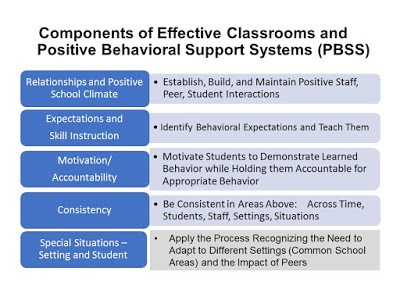
From: Knoff, H.M. (2014). School Discipline, Classroom Management, and Student Self-Management: A Positive Behavioral Support Implementation Guide. Thousand Oaks, CA: Corwin Press. CLICK HERE for more information.
_ _ _ _ _
Application and Commentary. The Stop & Think Social Skills Program is the anchor of Project ACHIEVE’s comprehensive School-wide Positive Behavioral Support System (PBSS). This PBSS system is one of Project ACHIEVE’s seven school improvement components (see www.projectachieve.info for more information), and it has been established as an evidence-based model that focuses on the multi-tiered system, school, staff, and student services, supports, strategies, and interventions that result in (once again) effective school discipline, classroom management, and student self-management outcomes.
More specifically, the comprehensive outcomes from Project ACHIEVE and its PBSS model include:
- Creating safe school environments and positive school climates;
- Increasing and sustaining effective classroom instruction;
- Maximizing students’ academic engagement and achievement;
- Maximizing students’ social, emotional, and behavioral success;
- Increasing and sustaining strong parent involvement;
- Developing and implementing effective strategic plans and professional development to build staff skills and school capacity;
- Organizing effective building committees and professional learning communities;
- Building effective teaching and problem-solving teams that speed successful interventions to academically struggling and behaviorally challenging students; and
- Developing effective data management/dashboard systems for successful formative and summative outcome evaluations.
Because, as they say, a “picture is worth a thousand words,” below is a brief 10-minute video reviewing (a) the five interdependent and scientifically-based components of school discipline, classroom management, and student self-management; and (b) Project ACHIEVE’s success in implementing the PBSS model state-wide as part of a multi-year Arkansas Department of Education initiative:
Summary
This three-part Blog Series began by presenting the research that calls many of the Mindfulness approaches into question—later contrasting that research with the many studies that support social, emotional, and behavioral skill instruction for all students in all classrooms.
The critical conclusion was:
If the primary goal of a Mindfulness program is to help students to be more aware and in control of their emotions, thoughts, and behavior, why would we not focus on the same goals—but use a research-based approach that has a 30-year track record of success?
In the second and this third part of the Series, we have presented eight essential Principles that reflect the research-to-practice elements of sound and effective social skills instruction. When discussing each of these Principles, we have used examples from the evidence-based Stop & Think Social Skills Program to demonstrate some prototypical ways of successfully teaching students social, emotional, and behavioral self-management.
I hope that this Blog Series has helped you to evaluate your current (or missing) approaches in this important area, and to see more clearly the components and decisions that are most-relevant to your school discipline, classroom management, and student self-management approaches.
I also hope that you had a great Thanksgiving, and that you will “pace” yourself as we enter the “Holiday rush.”
Meanwhile, I always look forward to your comments. . . whether on-line or via e-mail.
If I can help you in any of the student support and intervention areas discussed in this message, I am always happy to provide a free one-hour consultation conference call to help you clarify your needs and directions on behalf of your students.
Best,